
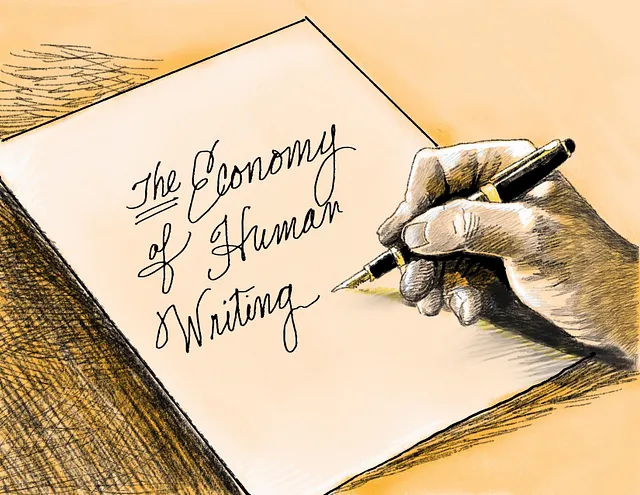
Feature image illustrated by a human — Jojo Teckina
Not yet a Medium member? Read for free with this friend link.
When the topic of AI-generated images comes up in my writing community, I’m compelled to speak up. This is a gut-level response I won’t let myself ignore.
Since day one here on Medium, I’ve been a fan of the platform’s stance on seeking and eliminating AI-written work. It’s generated at a pace no human can keep up with, wasting time and redirecting money away from hard-working writers.
I believe my somatic reaction to AI-generated art is triggered by my brand-consistency radar. The best businesses in the world are razor sharp about the promises they make — and relentless about delivering on them.
When a brand promises written work by humans and delivers art by robots, it feels to me like a broken promise.
The goal of a feature image is to draw the attention of a prospective reader. Just as AI-written posts take eyeballs away from human-made stories, AI-images take business away from the human artists who are vital to our writing ecosystem.
These artists are illustrators, photographers, and designers.
In addition to the art of writing, here on Medium, we can find humans who are musicians, potters, painters, and chefs. They are filmmakers, voice actors, and makeup artists.
They are us.
And as us, we need to support all of us human artists.
I’m guilty.
I’ve resorted to using AI-generated art. Each time I did it, I felt like I was being disrespectful to the community.
It’s tempting to use AI for images. It’s instant gratification. It’s one less barrier.
This is my 168th published piece on Medium. For eleven of them, I spent my hard-earned money on AI-generated images. And that’s your hard-earned money, too.
I’m calling this list “My AI Wall of Shame.”
List: My AI Wall of Shame | Curated by Andrew J. DiMeo, Sr., Ph.D. | Medium
My essays now feature personal photos or showcase another human’s art. It takes time, but I’ve found that paying someone to produce a feature image feels good. It’s an investment back into the ecosystem.
Through this evolution, I discovered how much more I enjoy a story when the author uses personal photos or creates their own cartoon. The ones with AI-feature photos cheapen the story for me.
I’m hungry to find more stories that string together words and images crafted by real people.
It turns out that’s hard to do. Publications that foster human-made feature photos along with original writing are hard to come by.
The process of getting human-made art featured in our writing isn’t easy. It might include an ask for support. It takes time. But my experience has been positive. It’s turned into meaningful relationships. I’ve found that investing in hard-working people has been worth it.
I’m calling this “The Economy of Human Writing.”
What drew me to the Medium Partner Program in the first place was its “a rising tide raises all ships” business model. Paying for subscriptions supports the whole ecosystem.
The worlds of Substack, “Tip Me,” and “Buy me a coffee” didn’t previously resonate because they felt self-centered.
They scream, “Invest in me.”
I was looking for “Invest in us.”
But I was wrong — at least in thinking those choices were separate.
The genuine humans among us know that writing costs real money.
There are operating expenses — tools, software, storage, production, and distribution.
None of this is a surprise to people who make a living as writers and artists. It’s simply what it takes to produce work that reaches people. Without you, my dear reader, no story makes a dime.
But what happens when we do make a dime? Rather than give it to an image generator, I’m choosing people over shortcuts.
How did you arrive here? What drew you in to read this opinion? The algorithm rewards great titles, an engaging feature image, and a strong hook in the first sentence.
This is where illustrators, photographers, and designers shine in the writing economy.
Believe it or not, I’m not anti-AI. It’s an instrument for research, note-taking, brainstorming, and first pass editing. I don’t do what it tells me to do, and I don’t ask it to do the job for me. It’s a tool.
But those images on my AI Wall of Shame — that’s me being impatient. That’s letting the machine do the creative work for me.
It’s nuanced. Just as it’s not wrong for writers to use a chatbot for research, artists of all types may very well utilize modern tools that are AI-enabled.
Technology is part of art. I’m not etching this opinion onto a stone tablet.
Consider, for a moment, the piano. It’s a technological marvel. We had a player piano in my house growing up. Rolls of paper with holes in them were the songs it could play all on its own. If I were to own a bar, I’d hire The Piano Man, not replace him with a roll of paper.
It’s all technology. Who uses it and how it’s used make the difference.
Hire a human editor and writing coach. Pay for live courses taught by real people. Share space with fellow writers. Buy books written by humans. Work with human artists. Support their work, learn from them, and enjoy their writing.
Sure, working with humans takes longer and costs more than all of my electronic solutions added together. But it’s worth it. Well worth it.
I find their work better. It’s warmer. We connect and form bonds.
Reinvesting in humans is living in the economy of human writing. Paying for shortcuts is sucking it dry.
When we’re thriving, we are reaching more people, enabling us to put more dollars into the pockets of the artists, designers, and editors who bring our stories to life.
Subscribe, like, comment, and share — that’s how this economy works.
Clicking on the work of humans is an investment in hard-working people. This is as much for the images that attract our eyes as it is for the words that follow.
Let’s stand together and support all of the humans who work so hard to bring our stories to life. That includes the good people working behind the scenes of this very platform.
Thank you for reading. Your support is an investment in the entire ecosystem of all human creatives.